Comfort in a time of Chaos

Dear Hearts…

How are you holding up in these uncertain times?

It has been quite a long time since I’ve shared my voice here. I’ve been on a hiatus to focus on furthering my studies. Now, having completed a Masters in Sustainable Agriculture degree, moved house, renovated and taken a moment to recover from the state of burnout I pushed myself into, I feel more ready and able to return to this space.

And so, as it happens, I am returning at a time when the news cycles seem heavier than usual lately. Every scroll through our phones brings another story of geopolitical tensions, war drums beating somewhere in the world, economic instability, and a lingering sense that the ground beneath our collective feet is shifting in ways that we cannot control. Even if these events are unfolding far from our homes, their emotional tremors travel easily across borders. They reach us in the quiet moments — in the tightening of our chests, the low hum of worry, the questions about what the future might hold.

I’ve been asking myself – how to I create sense of security and comfort in a time of chaos?

In times like these, I find myself reaching to the familiar embrace of nature, growing my own food, grounding in green spaces, breathing and moving through forested paths on daily morning walks. It’s a constant that makes me feel safe. In addition, I also find myself returning to certain books that have served as spiritual and psychological companions through several difficult seasons of my life. One such book is Man’s Search for Meaning by the Austrian psychiatrist and Holocaust survivor Viktor Frankl.

Those of you who read my book, Mending Softly, may remember that at times I leaned on Frankl’s work while navigating the grief of pregnancy loss, because during that fragile season his ideas offered me a kind of steady lantern — something to hold onto while finding my way through the dark.

Frankl’s insights were forged in the unimaginable conditions of Nazi concentration camps, yet the wisdom that emerged from that suffering speaks powerfully to all seasons of uncertainty — including the one we find ourselves in today.

So, with this in mind, I thought it might be meaningful to revisit some of the key lessons from his work and reflect on how they might help us navigate a world that sometimes feels unstable and frightening.

The Freedom to Choose Our Response or Attitude

One of Frankl’s most enduring observations is that even when everything else is stripped away, we retain the freedom to choose our response to what is happening around us.

He wrote that everything can be taken from a person except one thing — the last of the human freedoms: to choose one’s attitude in any given set of circumstances.

This lesson has surfaced for me frequently over the years because it is both humbling and empowering, and perhaps even more so lately, as I find myself in an unusually reactive state of fear. Yet this idea is reminding me that, yes, there are so many things in life we cannot control: global conflicts, political decisions, economic systems, natural disasters, illness, loss. But within that vast landscape of uncertainty there remains a small but powerful territory that belongs entirely to us — our inner posture toward life.

During my own grief journey, as described in Mending Softly, I remember reaching a moment where I realised I could either sink deeper into despair or gently reach back toward life again, breath by breath. I began asking myself – what is thriving in my life, and what is thriving around me? – doing my best to redirect my attention to those things. Hand in hand with that, Frankl’s work reminded me that meaning and dignity are often found in that quiet act of choosing how we show up to what is.

Meaning as a source of Sustenance

Frankl believed that the deepest human drive is the search for meaning.

Not the fleeting rush of happiness.

Not success.

But, meaning.

In the concentration camps he observed that prisoners who held onto a sense of purpose — be it the thought of a loved one waiting for them, a piece of work left unfinished, a responsibility yet to be fulfilled — were often more resilient in the face of unimaginable suffering.

Meaning, in other words, can become a lifeline, a driving force that sustained them.

Granted, in our modern world the challenges or threats we face may look different, but the principle remains the same. When the world feels chaotic or frightening, reconnecting with what gives our lives meaning can anchor us again.

Your meaning might live in your relationships.

In your creative work.

In caring for your family.

In tending a garden.

In offering kindness where you can.

These seemingly small acts are not insignificant. They are threads of meaning that weave stability into an uncertain world.

Love as a Source of Strength

Another striking theme in Frankl’s writing is the power of love.

During his imprisonment, he often survived emotionally by imagining conversations with his wife and reflecting on the depth of his love for her. Even when separated from those we love, he believed that love remains a profound source of meaning and inner strength.

In a time where global tensions can make humanity seem so fractured and hostile, I feel that this is a particularly important reminder.

Expressed through compassion, empathy, and connection — love remains one of the most quietly radical forces we have available to us, especially because it reminds us of our shared humanity.

Suffering Can Be Transformed

Frankl never romanticised suffering. But he did suggest that when suffering is unavoidable, we still have the ability to transform how we carry it.

Again, this is a reminder that while we cannot always choose what happens to us, we can choose whether suffering becomes a place where meaning ends — or a place where meaning begins.

This idea was deeply personal for me during the season that eventually became Mending Softly, something I reflect on more specifically in the chapter on Post Traumatic Growth. Loss broke something open in my life. Yet slowly, through reflection, writing, and community, I discovered that the experience could also become a source of compassion, connection, and purpose.

The pain did not disappear. But it became woven into a story of resilience rather than despair.

Living Responsively to Life

Lastly, probably one the most beautiful ideas that Frankl’s work offers is that instead of asking what we expect from life, we might consider what life is asking of us.

Each moment presents us with a question.

How will we respond?

What will we choose?

What kind of human being will we be in this situation?

These questions feel particularly relevant in a world where fear and division often dominate public discourse.

Perhaps life is asking us to cultivate steadiness.

Perhaps it is asking us to practice compassion.

Or, perhaps it is inviting us to become small pockets of calm, kindness and meaning within a turbulent world.

A Gentle Invitation

So today, dear hearts, I leave you with a few reflective questions that echo Frankl’s philosophy:

What gives your life meaning right now?

What small acts of kindness or creativity could you offer the world today?

And perhaps most importantly:

What is the most life-affirming response available to you in this moment?

Even in uncertain times, meaning remains available to us. Often it lives in the quiet, everyday choices we make — the way we care, the way we create, the way we continue showing up for life despite its fragility.

And sometimes, simply continuing to breathe, love, and hope is its own quiet form of courage.

With warmth.

Jodi Sky
Trying Out ‘The High 5 Habit’ During the Luteal Phase

Dear Hearts…

The year is marching on, the seasons shifting in one direction or the other depending on which corner of the earth you find yourself. Here, in my own little haven, I’ve been breathing more deeply, making the most of the deliciously dry and sunny early winter days while I am quietly laying the foundation for the upcoming book projects, content and resources that I’m working on. 

If you follow my work, then you already know that I am passionate about exploring various methods of cultivating calm, relieving anxiety and ultimately developing a balanced sense of self, even in the face of adversity. So, when new mindfulness or personal development tools are on my radar, I am always intrigued to investigate and experiment with integrating them into my personal self-care (or soul care) practices. That said, a few months ago, all the buzz and positive reviews around renowned author, Mel Robbins’, latest self-help book, The High 5 Habit: Take Control of Your Life with One Simple Habit, caught my attention. Robbins describes the ‘High 5 Habit’ as a “holistic approach to life that changes your attitude, your mindset and your behavior.” Robbins shares that she began cementing this somewhat peculiar habit in her own self-care routine during a particularly challenging period of her life when she was, “exhausted, beaten down and burnt out”. She immediately noticed the positive impact her new habit had on her, how it uplifted her energy and catalyzed a profound shift in her relationship with herself. When she began sharing her ‘high 5 habit’ online during the pandemic, she was blown away by the effect it had on people who also started practicing it. 

What Exactly is the ‘High 5 Habit’? 

To practice this very simple approach, she guides readers and online challenge participants to start the day by taking a few minutes to connect with themselves in front of the mirror. The general instructions for the process are as follows:  

When you brush your teeth in the morning, take a few minutes to look at yourself in the mirror. 

Set an intention for the day. 

Think about how you are going to show up, who you are going to be and what matters most to you in terms of the areas you want to make progress in for that particular day. 

Then you raise your hand and high five your reflection in the mirror to seal the intention. 

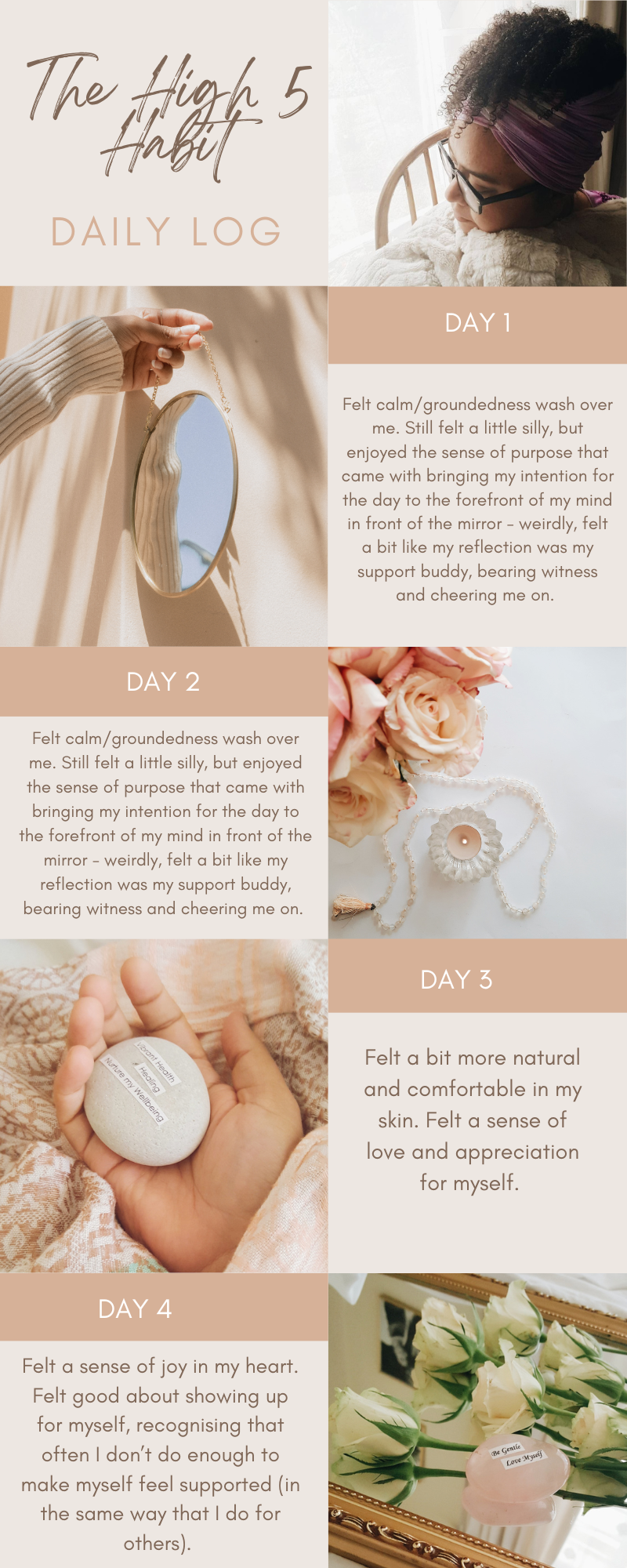
In all honesty, at first glance, the ‘high 5 habit’ seemed a bit cheesy. I am big on setting intentions and journaling in the morning (see my latest journal Soulful Sunrise: A Mindful Morning Reflection Journal available on Amazon), and although I’m also familiar with the concept of ‘mirror work’, its benefits and have done many such exercises, I wasn’t quite sure how Mel Robbins’ method would be any different to that. Out of curiosity, I decided to go ahead and just be open to the possibility that it may surprise me. I figured that the luteal phase would be a great time for me to experiment with Robbins’ method. It’s the period of the female cycle that often brings up all kinds of strong emotions, anxieties and when we may feel drained or fatigued. It is the period of time when my inner critic surfaces, so I am more likely to list all my perceived failings and go down a negative spiral. We often fall into the trap of nitpicking our appearance and berating ourselves during those moody premenstrual days. And of course, on cycles where you happen to be trying to conceive (TTC) or going through fertility treatment, the emotional turmoil and anxiety can be even more pronounced during the two week wait (TWW). Mindfulness exercises, art therapy, tea meditations and yoga have all been beneficial resources for me to lean on during the TWW. So, uncertain of what to expect, I was curious to explore whether the ‘high 5 habit’ could be another nurturing tool to add to the mix. On cycle day 15, the first day of my luteal phase, I showed up in front of the bathroom mirror, looked into my own eyes in the reflection and followed through with the ‘high 5 habit’ guidelines. I kept a basic log of my experience, and here is a glimpse at what I noticed over the course of the first seven days:  

By the end of that first week, I could appreciate what Mel Robbins had been talking about. Robbins puts forward that because of the positive association with the act of high-fiving, it immediately stirred up feel-good energy, making it easier to cultivate affirming thoughts rather than self-deprecating ones. I certainly noticed that. I enjoyed the feeling of unexpected comfort, calm and inner joy that it awakened in me. I was also very aware of how it enabled me to keep my inner critic in check. 

Reviewing the book in her Success.com article, writer, Natasha Lavender, summed it up perfectly when she wrote: 

“You’ve probably performed this gesture hundreds of times before. Your brain subconsciously knows what a high-five means: celebration, reassurance, teamwork, determination. So when you give your reflection a high- five, your brain automatically gives you that little thrill you get when you do it with someone else. It tells you that you’re cheering on the person you’re high-fiving—in this case, yourself.”

In essence, we have a psychological predisposition to mine uplifting thoughts and feelings when we carry out a simple physical act that has an associative feel-good factor. Put that way, the impact of exercise makes a lot of sense.  

Lavender’s article goes further to say that: 

“Facing yourself in the mirror can be an intimidating experience. Not because of the things you don’t like about your reflection, but because it makes you take stock of all the life experiences you’re carrying around. That includes sad things that have happened to you, and bad things you’ve done that you haven’t forgiven yourself for. That’s why a high-five is such a perfect gesture for repairing that relationship with yourself. It’s lighthearted, but it also means something serious: We’re on the same team, and I’m going to be here for the struggles and the celebrations.” 

The feeling of being fully held, seen and supported is truly underrated and this was one of the exercises that showed me the extent to which we support others, but regularly and often unconsciously abandon or disassociate from ourselves. Are we as happy to see ourselves in the mirror as we are when we see a friend or loved one? Do we offer ourselves nurturing internal dialogue when we’re feeling low (the way we would a friend) or do we berate ourselves further? Robbins found that many of us either ignore or criticize ourselves in the mirror. Practicing the ‘high 5 habit’ reminded me on a daily basis that I owe it to myself to be more present and compassionate to ME. It also reinforced that each day I have a choice as to how I show up, a choice to focus more intently on what matters most to me and that in itself is empowering regardless of the many pear-shaped things I am unable to control.

 A Forbes article by speaker and author, Blake Morgan, reminds us that:

“No one is immune to challenges and dark times. The strain of the world and work challenges can feel overwhelming and isolating, especially for entrepreneurs. But the simple habit of taking just a few minutes for yourself and giving yourself a high five can change your day, and over time can change your life. When you’re excited to see yourself and cheer yourself on, you can take control of your life and make amazing things happen.”

Whether you experiment with the ‘high 5 habit’ or not, the sentiment rings true in any situation – When you show up for YOU and meet yourself with compassion, you rebuild your relationship with yourself. You rebuild your sense of self-worth (and boy has my self-worth needed a lot of repairing I’m the midst of subfertility and pregnancy loss). You make empowering decisions that benefit your wellbeing and personal growth. You are reminded that you deserve your own love, kindness and devotion just as much as everyone else in your life does.

Have you read the book, “The High 5 Habit”? Have you tried out this practice? What was your experience like? 

If not, which practices help you connect with and nurture yourself? 

Nurturing Your Heart on Mother’s Day 


Dear Heart, how are you feeling this week? 

Are you finding ways to support and comfort yourself through the sticky moments of this journey? 

There is a lot going on at the moment. This past Sunday marked ‘International Bereaved Mother’s Day’. It is also ‘Maternity Mental Health Week’ in various countries at the moment, and of course Mother’s Day is coming up on Sunday, 8th May. It can be a confusing and bittersweet period where we each do our best to walk the fine line between grieving loss and infertility, and celebrating motherhood/the mothers in our lives. 

In recent years, I’ve noticed more and more awareness around and consideration towards the infertility and pregnancy loss community. I’ve seen many touching posts offering support to women dealing with infertility and to those who’ve experienced losses on social media over the last week, as well as a lot more media coverage on these topics. A few companies have also shown some sensitivity with their email lists, giving subscribers the option to opt out of receiving any Mother’s Day related correspondence as they are aware that it was a difficult time for some.

I appreciate these small thoughtful gestures because they are indicators that wider society is acknowledging the emotional and mental impact of infertility and pregnancy loss. It gives me the sense that years of speaking out, educating and advocating for understanding and sensitivity towards women who struggle with infertility and how it affects their lives is paying off, is helping to shatter the silence, the stigma and the shame that often accompanies it. It opens up space for those of us who face infertility to feel seen and it says – ‘You’re not forgotten, your loss is not forgotten, we see your pain and you’re included in our societal narratives’. Being seen, acknowledged and included is profoundly healing in many ways. With this as a foundation, my hope is that it becomes easier to keep building forward, allowing women/couples to better access the support and resources that they need.

Nurturing Your Heart

Even so, this week may still be a challenging time that amplifies your hurt and sense of longing for motherhood. It also doesn’t erase the realities and the pain of your struggle that you face on a daily basis.

“Despite the overwhelmingly positive narrative of Mother’s Day that we see in commercials and advertisements, we know that this is a tough day for people experiencing infertility and loss. And it is important to remember that for many, this day is even more emotionally fraught if their own mothers have passed away, if they have conflictual or complicated relationships with their mothers or if they have one or more kids but have also lost pregnancies, infants or children. This day can catch us up in so many layers of sadness, anger, jealousy and profound grief.”  

~ Dara Roth Edney

So, I’ll offer this gentle reminder: Remember that you are not alone. You are entitled to your feelings, be kind to yourself and give yourself permission to do things that nurture your wellbeing. If you feel the need to, then by all means, disconnect from social media and all the Mother’s Day messaging and take some time to do things that you enjoy. It is okay to set boundaries to protect your emotional health.

“Keep those rivers of self-compassion and love flowing over you, with an abundance of patience and kindness.”

~ Shannon, Mothering Your Heart

Three years ago, shortly after my ectopic pregnancy loss I came across a wonderful email series called Mothering Your Heart (https://www.motheringyourheart.com) This email series was created as a support resource for women after pregnancy loss. Around Mother’s Day they sent out a series of soul soothing emails. These daily messages were beautiful anchors for grace and came with a workbook of journaling prompts. One of these writing prompts was about ascertaining the best way for you to access calm on Mother’s Day. They asked several questions along the following lines:

• What is the most soothing place I could physically be today?

• What is the most calming event I might include in my day?, and

• What is the most comforting music that I’d like to listen to today?

Just having these simple thinking points to guide me forward brought some ease to something that could have been much more emotionally challenging. The contemplations felt so healing to me. It gave me something different to focus on, allowing me to spend my weekend taking care of my own needs.  

“…be proactive about taking care of yourself. Take the time leading up to Mother’s Day to try and anticipate what will make the day or weekend harder, and then take steps to protect yourself.”

~ Dara Roth Edney

I’d thus like to encourage you to contemplate what your needs are right now and then investigate how you can nurture them this week. 

What is your heart calling for most at this time? 

How can you hold yourself in self-compassion? 

Don’t be afraid to give yourself these things. Set self-nurturing boundaries in order to prioritize your own needs if necessary. Set aside self-judgement and meet yourself with acceptance and compassion. Nurture yourself and your heart lovingly. 

I’ll end off by sharing a verse from a moving affirmation that I stumbled upon last year, as it really touched my heart. It is called ‘Mothering Heart’ by Carly Marie, and reads as follows:

“While I may not have any children here to raise on Earth, I became a mother the moment I opened my heart to the idea of bringing a child into this world. My mothering love has grown and blossomed since that day.”